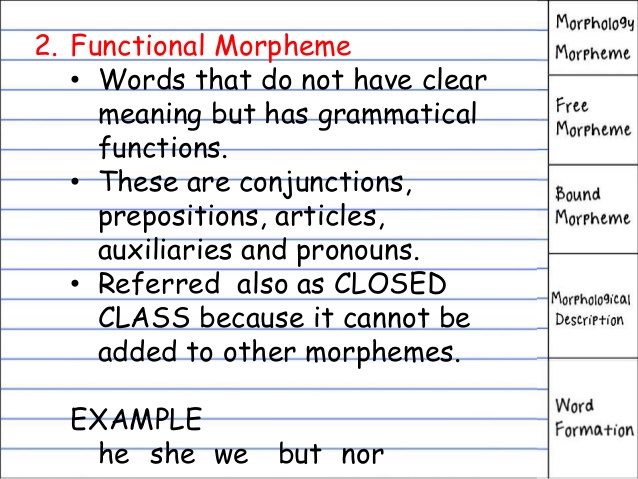
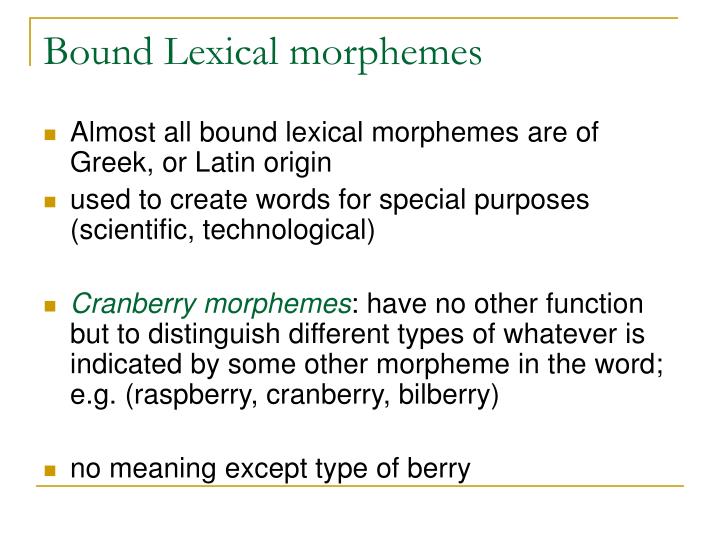
Lexical Morpheme : Derivational Morpheme | Word | Adjective : But the distinction is not all that well defined.nouns, verbs, adjectives ({boy}, {buy}, {big}) are typical lexical morphemes.prepositions, articles, conjunctions ({of}, {the}, {but}) are grammaticalmorphemes.. Morphology definition morphology is the study of word formation, including the ways new words are coined in the languages of the world, and the way forms of words are varied. A lexical item (lexical word) is what we normally recognise as the ordinary word. Grammatical morphemes have a job rather than a meaning. In his book the secret life of pronouns (2011. Using the same example, the lexical morpheme of the word unkindness would be the morpheme kind.
(1) lexical and grammatical morphemes: A morpheme is the smallest meaningful lexical item in a language. Syllable is a unit of pronunciation having one vowel sound, with or without surrounding consonants,. Lexical morphemes are the meaning bearers of sentences. They serve as carriers of the information being conveyed in a sentence.
A Walk in the World of WoRds : Morphemes Make Creative Words from 4.bp.blogspot.com They are nouns, adjectives, adverbs and verbs. Grammatical morphemes have a job rather than a meaning. Classify an intertwined language as a language that has lexical morphemes from one language and grammatical morphemes from another. A morpheme is the smallest meaningful lexical item in a language. Morphemes include conjunctions, interjections, determiners and prepositions; A morpheme is not necessarily the same as a word.the main difference between a morpheme and a word is that a morpheme sometimes does not stand alone, but a word, by definition, always stands alone. Because they have their own meaning, they can stand by themselves. These types of free morphemes are called lexical morphemes.
Lexical morphemes are the meaning bearers of sentences.
‐ linguists sometimes add locutions and pronouns to these eight parts of speech. A morpheme is not necessarily the same as a word.the main difference between a morpheme and a word is that a morpheme sometimes does not stand alone, but a word, by definition, always stands alone. Also known as semantic morpheme (semantic=meaning), these morphemes are the basic units of the word that do carry a meaning on its own. A lexical morpheme is a root word (noun, adjective, etc.). A lexical morpheme is but one type of morpheme. In order to identify a derivational morpheme, ask yourself this question: But grammatical morphemes are nouns, adjectives and adverbs. These types of free morphemes are called lexical morphemes. In order to identify a lexical morpheme, ask yourself this: These morphemes transform words into different parts of speech. But the distinction is not all that well defined.nouns, verbs, adjectives ({boy}, {buy}, {big}) are typical lexical morphemes.prepositions, articles, conjunctions ({of}, {the}, {but}) are grammaticalmorphemes. Lexical morphemes are the meaning bearers of sentences. These free morphemes are called lexical morphemes and some examples are:
A lexical morpheme is any morpheme that carries unpredictable meaning. Because they have their own meaning, they can stand by themselves. A morpheme is the smallest meaningful lexical item in a language. Morphemes that transform words into different grammatical categories from the root word (a free morpheme). A linguistic paradigm is the complete set of related word forms associated with a given lexeme.
Linguistic Chapter 6 on emaze from userscontent2.emaze.com Lexical morpheme morphemes that carry the content or meaning of the messages that we are conveying. Lexical morphemes are the meaning bearers of sentences. Lexical morphemes are like boy, write, paper and pen. (boy, run, green, well (as in he did that well.)) it is to be contrasted with a grammatical morpheme, the purpose of which is to specify grammatical relations, or relations between words of a sentence. A free morpheme is a morpheme (or word element) that can stand alone as a word. Morphemes that transform words into different grammatical categories from the root word (a free morpheme). Using the same example, the lexical morpheme of the word unkindness would be the morpheme kind. A free morpheme is the opposite of a bound morpheme, a word element that cannot stand alone as a word.
Lexical morphemes are those that having meaning by themselves (moreaccurately, they have sense). If this morpheme was deleted, would i not be able to understand the main message of this sentence? if the answer is yes, then you have a lexical morpheme. The lexical morphemes are those morphemes that are large in number and independently meaningful. Lexical morphemes these morphemes carry 'content' of messages we convey. Using the same example, the lexical morpheme of the word unkindness would be the morpheme kind. They have independent meaning and are large ber. Lexical morpheme we can identify a lexical morpheme, lexeme, or lexical morpheme as one that provides the fundamental semantic content of a word. A functional morpheme changes the function of the root word. Lexical morphemes are the meaning bearers of sentences. Morphemes that transform words into different grammatical categories from the root word (a free morpheme). The distinction is not entirely back and white. Lexical morphemes consisting of four syllables or a single syllable are uncommon whereas morphemes consisting of more than four syllables have never occurred. All nouns, verbs, adjectives and adverbs are examples.
In english, when a morpheme can stand alone, it is. Lexical morpheme lexical morpheme adalah morpheme yang dapat berdiri sendiri dan dapat menerima affix (imbuhan), baik suffix (awalan) atupun prefix (akhiran). In other words, lexical morphemes are content words. Many words in english consist of a single free morpheme. But grammatical morphemes are nouns, adjectives and adverbs.
PPT - Chapter 3 Lexical & Grammatical Morphology ... from image.slideserve.com A lexical morpheme is any morpheme that carries unpredictable meaning. In this way, it becomes the base to which other grammatical class morphemes can be added. Grammatical morphemes have a job rather than a meaning. Using the same example, the lexical morpheme of the word unkindness would be the morpheme kind. The field of linguistic study dedicated to morphemes is called morphology. A lexical morpheme is but one type of morpheme. Lexical morphemes are only one type of morpheme. The lexical morphemes include nouns, adjectives, and verbs.
We can add new lexical morphemes to the language rather easily, so they are treated as an open class of words.
Morphology definition morphology is the study of word formation, including the ways new words are coined in the languages of the world, and the way forms of words are varied. (boy, run, green, well (as in he did that well.)) it is to be contrasted with a grammatical morpheme, the purpose of which is to specify grammatical relations, or relations between words of a sentence. They serve as carriers of the information being conveyed in a sentence. In english, when a morpheme can stand alone, it is. These types of free morphemes are called lexical morphemes. Using the same example, the lexical morpheme of the word unkindness would be the morpheme kind. The field of linguistic study dedicated to morphemes is called morphology. Because they have their own meaning, they can stand by themselves. Lexical morphemes are the meaning bearers of sentences. A morpheme is the smallest meaningful lexical item in a language. But grammatical morphemes are nouns, adjectives and adverbs. In the name of allah, the entirely merciful, the especially merciful.video description is at the bottom. A lexical morpheme is one that can actually stand on its own without the aid of other morphemes to.